

Home / Resources
Clear guides and honest answers from the people who actually install solar. Read first, ask questions, and decide when you are ready. No pressure, no jargon.
From PM Surya Ghar updates to new panel technology, we cover what Gujarat homeowners, businesses and farms need to know before going solar.
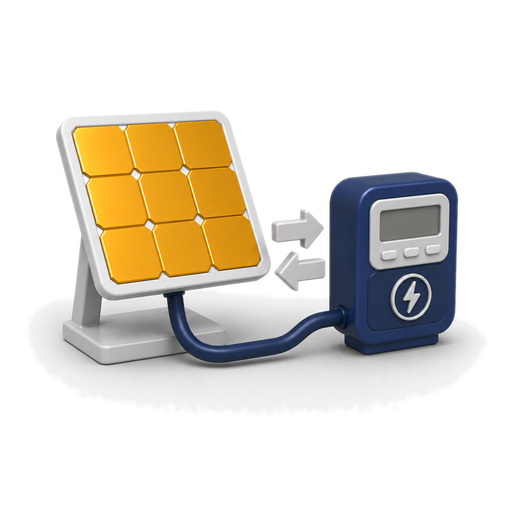
How a bidirectional meter credits your exported solar, the GERC rules, the ₹2.25/unit surplus rate, net vs gross metering, and a worked billing example.
Read article →
Why dust cuts output 10–25%, how often to clean, the right and wrong cleaning methods, heat and inverter care, coastal-salt protection, and realistic AMC costs.
Read article →
Roof suitability, sizing, ALMM/DCR panels, warranties, installer selection, subsidy, and payback. The complete pre-purchase checklist.
Read article →
Verified subsidy amounts, eligibility rules, step-by-step Gujarat application process, real costs and payback, and common mistakes to avoid.
Read article →
Efficiency, temperature performance, degradation, price, DCR policy, and which panel type is right for your situation in Gujarat.
Read article →
Size from your bill, not your roof. Per-kW generation, the PM Surya Ghar sweet spot, roof area, sanctioned load, and worked examples.
Read article →
Backup, batteries (lithium vs lead-acid), subsidy eligibility, costs, and which system suits your home or business in Gujarat.
Read article →
The PM Surya Ghar collateral-free loan at ~6.75%, bank products, EMI examples, and CAPEX vs OPEX/RESCO for businesses.
Read article →
How payback and ROI are calculated, per-kW costs and generation, the self-consumption vs export gap, and worked examples.
Read article →Before you call us, read this. Real client questions answered with complete honesty by the team that actually installs solar across Gujarat.
A rooftop solar system is a set of panels installed on your roof that convert sunlight into electricity for your home or business. The panels feed their output to an inverter, which converts solar power into the standard electricity your property uses to run lights, fans, air conditioning and machinery. During the day you draw on free solar power; at night or in cloudy weather you simply use the grid as normal. In effect, your roof becomes your own small power plant.
The right size depends on your monthly consumption, shown in units (kWh) on your electricity bill. As a guide for Gujarat, a 1 kW system generates roughly four units per day, so a 3 kW system produces around twelve units daily and a 5 kW system around twenty. Many Gujarat homes with monthly bills of ₹2,000 to ₹4,000 are well suited to a 3 kW system. We study your past bills and recommend the right size, so you neither overspend nor fall short.
You need approximately 32 sq. ft. of shadow-free roof per panel (600 Wp), which works out to about 54 sq. ft. per kW. A 3 kW system needs roughly 160 sq. ft. and a 5 kW system around 288 sq. ft. The area should receive good sunlight for most of the day, free from shadows cast by water tanks, walls or trees. Both flat terraces and clear sloped roofs work well. During our free site visit, we measure your roof and confirm exactly what will fit.
Quality solar panels typically last 25 to 30 years, often longer. They lose only a small fraction of output each year, around half a percent, so even after 30 years they still generate roughly 80 to 85 percent of their original power. Most panels carry a performance warranty of 30 years or more. A solar system is best viewed as a long-term asset for your property, not a short-term purchase.
Cost depends on system size, measured in kW (kilowatt). As a guide for Gujarat in 2026, before any government subsidy, a 1 kW system is around ₹70,000 to ₹1,10,000, a 3 kW system around ₹1.65 to ₹2.0 lakh, and a 5 kW system around ₹2.5 to ₹3.0 lakh. After the government subsidy, a 3 kW home system can come down to roughly ₹90,000 to ₹1.2 lakh. The final price varies with panel brand, inverter type and your roof, which is why we always provide a clear written quote after inspecting your site.
Solar can reduce a significant portion of your monthly bill, and many homeowners cut it substantially once the system is correctly sized. The exact saving depends on your daytime usage, system size and tariff. We do not promise a fixed figure, because every home is different, but we will show you an honest, realistic estimate based on your own bills. Over 25 years, these savings typically far exceed the cost of the system.
The payback period is the time it takes for your bill savings to equal what you invested in the system. For a typical Gujarat home, after the government subsidy, this is usually about three to five years. After that, you enjoy roughly twenty more years of low-cost electricity from a system that has already paid for itself. We provide an honest payback estimate based on your real bills, never an exaggerated promise.
The physical installation on your roof is usually quick, often one to three days for a standard home system. The full journey from booking to switch-on takes a few weeks, however, because of paperwork, government approvals and the net meter fitted by the electricity company. Larger commercial and industrial systems take longer depending on size. We handle every step and keep you updated throughout, so there are no surprises.
We manage all five stages end to end, so you can relax.
A standard on-grid system, the most common and affordable type, switches off during a power cut for safety reasons, so it does not provide backup on its own. If you want power during outages, a battery can be added through a hybrid system. During the monsoon, panels still generate electricity from daylight, simply less than on bright days. Gujarat enjoys strong sunshine for most of the year, so over a full year the system comfortably makes up for cloudy days.
It is the central government's flagship scheme to help homeowners install rooftop solar by crediting a cash subsidy directly into their bank account. Launched in 2024, it aims to bring solar to one crore homes across India and is fully active and funded in 2026. Gujarat leads all states in installations under this scheme, and Ahmedabad is among the top cities, so you are in well-established company.
The residential subsidy in 2026 is fixed and clear:
The subsidy is capped at ₹78,000 even if your system exceeds 3 kW, and it applies to residential systems only. We help you claim the full amount you are entitled to.
You apply online at the official portal, pmsuryaghar.gov.in, using your electricity bill number and a mobile OTP, then select a registered installer such as us. After approval, installation and inspection, the government credits the subsidy directly to your Aadhaar-linked bank account. The current aim is to release the payment within about fifteen days of a valid claim, though in practice it can take a few weeks. We manage the entire online process for you, so the paperwork is never your concern.
The principal benefit is the central subsidy of up to ₹78,000. Gujarat operates its own single-window rooftop programme, SURYA Gujarat, which is linked to the national scheme to make applying easier. Any additional state-level assistance can change from year to year, so we do not promise a fixed extra amount. During your free assessment, we check what is currently available for your specific case and advise you honestly.
Net metering uses a two-way meter that records both the power you draw from the grid and the surplus solar power you send back to it. The units you export are adjusted against the units you import, so you are billed only on your net usage, much like a give-and-take account with the electricity company. As of 2026, Gujarat allows net metering for home systems from 1 kW up to 1 MW, letting your daytime surplus reduce your overall bill. For a full explainer, see our net metering guide.
Under net metering, the surplus units you export are adjusted almost one-for-one against the units you consume, which is very favourable. Under net billing, exported power is paid at a lower rate than the price you pay to buy power. Gujarat homes currently remain on the more beneficial net metering system. A new draft rule discussed in 2026 mentions net billing, but it is not yet law, and we keep our customers informed whenever any change is confirmed.
When your panels generate more than you use, the surplus flows into the grid and is adjusted on your bill through net metering. If, across the full year, you still have leftover units, the electricity company pays a small fixed rate for them at year-end. The greatest benefit, however, comes not from selling power but from using your own solar directly and reducing what you buy from the grid. That is precisely why we size your system to match your actual usage.
TOPCon is the leading mainstream panel technology in 2026 and is more efficient than older designs. Efficiency refers to how much sunlight a panel converts into electricity, and TOPCon converts more, giving you greater output from the same roof space. These panels use N-type cells, which handle heat better and degrade more slowly, a genuine advantage in Ahmedabad's climate. Compared with older Mono-PERC panels, TOPCon delivers better long-term performance, and we recommend it for most homes and businesses today.
Bifacial panels generate electricity from both their front and rear surfaces. The rear captures sunlight reflected off the roof beneath, adding extra output. They perform best on bright, reflective surfaces such as a light-coloured terrace. For a suitable roof, they extract more energy from the same area. We advise you on whether bifacial panels suit your particular roof during the site visit.
Panels have advanced considerably. A few years ago, a single panel produced around 330 to 400 watts; today's standard panels deliver around 575 to 600 watts, with some higher still. Higher wattage means fewer panels are needed for the same output, giving you more electricity from less roof space and a neater installation. We always use current-generation, quality-tested panels for your system.
A battery stores surplus solar power for use during outages or at night, but it adds significantly to the cost and is not covered by the government subsidy. For most Gujarat homes with a stable grid supply, a battery is optional, since net metering already lets you store value on your bill. A battery makes the most sense if you face frequent or extended power cuts and want reliable backup. We help you decide honestly, based on your needs and budget, without pushing you to spend more than necessary.
A hybrid system combines solar panels, the grid and a battery, all managed by a single smart device called a hybrid inverter. This arrangement delivers solar savings during the day and backup power during outages, switching automatically as required. It costs more than a standard on-grid system because of the inverter and battery. Hybrid systems suit homes and businesses that want both savings and dependable backup, and we can design one to match exactly how much backup you need.
Yes, solar is an excellent and increasingly popular way to charge an electric car or scooter. A 3 kW system generates around twelve to fifteen units a day, usually enough to cover a normal daily commute plus part of your home's needs. With net metering, your daytime solar credits can offset the power used to charge your vehicle at night, often without a battery. Charging from home solar costs far less per kilometre than petrol.
Under the PM Surya Ghar scheme, several public sector banks offer collateral-free loans (no asset to pledge) for home systems, with concessional interest rates and tenures of up to ten years. The government subsidy is also credited into your loan account, reducing the amount you borrow. State Bank of India and others provide these through a simple online process linked to the scheme. We guide you through the current options so you can choose what suits your budget.
AMC stands for Annual Maintenance Contract, a yearly service plan that keeps your system performing at its best. It typically covers panel cleaning, electrical safety checks, inverter health checks and monitoring support, along with a generation report. Regular maintenance matters because dust and neglect can quietly reduce your output and savings. An AMC is an optional but worthwhile way to protect your investment over the long term.
Solar panels need very little care, as they have no moving parts. The main task is simple cleaning, washing dust off the panels every fifteen to thirty days, since Ahmedabad's dusty conditions can lower output. Beyond that, an occasional check of the wiring and inverter keeps everything healthy. Our Annual Maintenance Contract (AMC) handles cleaning, safety checks and monitoring for you. Overall, maintaining a solar system is far easier than most people expect.
Yes. In 2026, mobile-app monitoring is standard. Through a simple smartphone app, you can see your daily generation, track your savings and receive alerts if anything needs attention. This means you always know your system is working properly, even when you are away. We set up the app for you and show you how to use it.
A quality system carries strong, layered warranties:
We explain every warranty clearly in writing before you buy, so you know exactly what is covered.
The case for acting now is strong. The ₹78,000 subsidy is active, Gujarat still offers favourable net metering, and today's TOPCon panels are mature and efficient. Every month you wait is a month of electricity bills you could have been saving on. While technology always improves slightly over time, the savings lost by waiting usually outweigh the small future gains. The best first step is a free assessment, after which you can decide calmly with complete information, with no pressure from us.
We are an Ahmedabad-based solar EPC company founded in 2017, serving homes, businesses and factories across Gujarat for both private and government clients. EPC means we handle everything: Engineering (design), Procurement (supply) and Commissioning (installation and switch-on), so you deal with one trusted team from start to finish. We focus on honest advice, quality components, proper paperwork and long-term service. Our goal is a system that genuinely saves you money for decades.
Our guides cover a lot, but your situation is unique. Ask us directly and get an honest, specific answer within one working day.